Tatiana's Visit to Onegin's Abandoned House
Eugene OneginTattiana's Visit to Onegin's Abandoned House is a turning point in Tattiana Larina's understanding of Eugene Oneguine. She asks to inspect his mansion, enters the lonely house he has left behind, and studies the books he once read. The visit converts longing into an effort at interpretation: his marked pages offer her evidence, but what they reveal is not a simple key to his character. They lead instead to a troubling question about whether Oneguine is himself or a figure fashioned after literature.
The House and the Visit
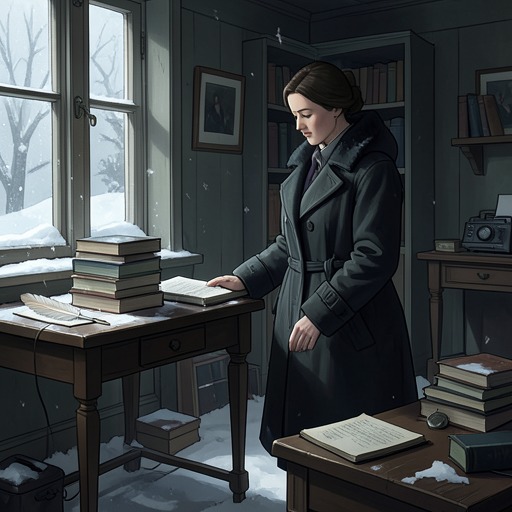
Tattiana asks to see the mansion and hurries to Anicia for its keys. Once the door is opened, she enters the lonely house where Oneguine spent a period of his life. Her purpose is not merely to look around: she asks to be shown the volumes he used to read, intending to return to them in the future. The sequence makes access itself significant. The house is no longer inhabited by the man whose presence gave it meaning, yet its rooms and books remain available to Tattiana as traces of an absent life.
The visit also brings Lenski into the house's history. Anicia recalls that the departed Lenski would often come there to dine in winter. His recollection places the two young men's former companionship within Oneguine's domestic surroundings, while the word “departed” carries the weight of Lenski's absence. The house therefore preserves more than Oneguine's solitary habits: it also holds a memory of a relationship that has ended in death.
From Grief to Reading
Tattiana is eventually left alone. She weeps for a long time, then tries to read; at first she has no inclination for books, but gradually their selection begins to engage her. The movement from tears to reading is not an abrupt escape from feeling. Grief precedes the investigation and shapes the conditions in which she undertakes it. The books are at once what she has come to examine and objects she can approach when Oneguine himself is absent.
Her decision to return to the volumes gives the encounter a continuing dimension. Rather than treating the house as a single visit or a final glimpse, Tattiana establishes a practice of reading there. That return makes the room a place where private sorrow can be followed by attention: she will look again, not simply at the empty dwelling, but at the intellectual traces Oneguine left in it.
The Books as Evidence
The volumes bear physical marks of their former reader. Numerous pages preserve the sharp incisions of Oneguine's fingernail, details Tattiana notices as she reads. These marks are concrete evidence of contact: his reading has altered the books, leaving an impression that Tattiana can follow after he has gone. The books do not disclose his thoughts directly, but the marked pages make his engagement with them visible and give her a material route into the question of who he is.
As she reads, Tattiana begins, slowly, to understand him more clearly. Yet the result is not a settled portrait. She asks whether he is an imitation, a bogey conjured up in jest, or “A Russian in Childe Harold’s cloak,” and considers the possibility that he might be angel or malevolent fiend. These alternatives show her trying to distinguish a real person from a recognizable literary pose. The question remains open: the books sharpen her judgment, but do not dissolve the uncertainty surrounding Oneguine's character.
Significance
The episode gives Tattiana a new means of knowing Oneguine. Earlier, her feelings were organized around the man she loved; here, the absent man becomes an object of study, approached through a house, a remembered visitor, and pages marked by his hand. Her slow understanding is a change in perspective rather than a simple revelation: literary reading helps her see that Oneguine may himself be shaped by literary imitation.
The form of the scene sustains that uncertainty. It moves from the practical request for keys, through the empty house and Tattiana's grief, to the patient scrutiny of books and the unresolved question of identity. The material traces offer intimacy without presence: a fingernail's incision shows where Oneguine touched a page, but cannot make him speak. Tattiana's visit thus turns abandonment into an act of interpretation, while leaving the interpretation unfinished.